Color as a Puzzle Language
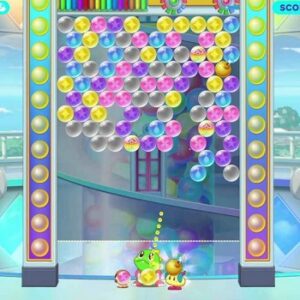
The Color tag gathers games that use hue, contrast, and ordering as core mechanics rather than simple decoration. In this group, color is often the rule-set itself: matching spheres in Bubble Shooter 3 and Puzzle Bobble, sorting liquid in Cups – Water Sort Puzzle, or arranging blocks and shapes in Tentrix, Block Champ, and Sandtrix. Even when the objective is less obvious, color remains the main signal that tells the player what matters, what fits, and what must change next.
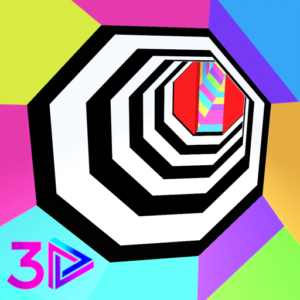
That makes the tag unusually broad. Some games ask for quick recognition under pressure, while others reward careful planning and visual organization. Color Tunnel and FL Tron use bright lanes and sharply separated tones to keep movement readable at speed. Blue Game and Red Game turn a single dominant color into a target condition, reducing the challenge to focus and precision. In contrast, Home Design: Decorate House and Funny Haircut use color to support creative decisions, where choices are less about survival and more about presentation.
Matching, Sorting, and Pattern Recognition
A large share of color-tagged games build on immediate visual comparison. Chuzzle, Bubble Shooter 3, and Puzzle Bobble all depend on spotting groupings quickly, while Tentrix and Block Champ ask players to place shapes in ways that preserve future options. The common thread is not just matching, but reading the board as a system of colors and openings.
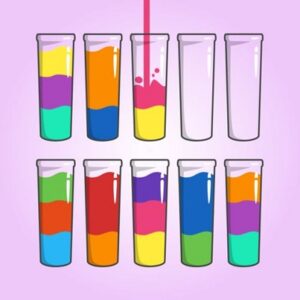
Cups – Water Sort Puzzle pushes that idea into a more deliberate form. Instead of rapid clearing, the player sorts layers by color and works backward from a cluttered arrangement toward order. Factory Balls and Factory Balls 2 also revolve around color logic, but they do it through tool sequencing and transformation. Rather than matching what is already visible, the challenge is predicting how a series of actions will produce the correct final result.
Color Under Pressure
Some games in the tag use color to intensify speed and spatial awareness. Color Tunnel is built around reacting to a rapidly shifting path, where colored surfaces help define the safe route. FL Tron uses clean neon distinction to keep momentum readable while the player manages tight movement and collision risk. In these games, color is functional first: it keeps fast action legible.
Pull the Pin follows a slower pace, but color still shapes the puzzle. Balls, obstacles, and targets must be read at a glance so the player can decide which sequence of pin removals preserves the right outcome. The same visual clarity matters in The Idiot Test, where the challenge comes from decoding instructions and noticing tiny distinctions quickly. Color does not always create difficulty directly; sometimes it makes the difficulty visible.
Creative Work Where Color Becomes a Tool
Another branch of the tag uses color as part of customisation and expression. Draw Tattoo and Ninja Painter involve applying color carefully to complete a design or satisfy a visual target. Home Design: Decorate House broadens that idea into room styling, where palette choices influence the feel of the space more than any single move or timer.
These games ask for different skills than the matching puzzles. Instead of finding the next legal move, players consider composition, balance, and visual consistency. Funny Haircut also fits this side of the tag because color is tied to grooming, styling, and visible transformation. The satisfaction comes from changing an object or scene until it matches a chosen look.
Simple Rules, Clear Visual Payoff
Color-tagged games often work because the rules are easy to read even when the decisions are not. Red Game and Blue Game reduce the premise to a direct visual condition. Sandtrix and Block Champ keep the controls straightforward while demanding board awareness and forward planning. That balance makes the tag accessible without making the games shallow.
The design pattern is consistent across the collection: players get immediate feedback, then learn to interpret that feedback more efficiently. Whether clearing bubbles, sorting liquids, or placing shapes, success depends on noticing color relationships faster and using them with more precision. That is why the tag works across such different genres. Color is not just a theme here; it is the organizing principle that ties reaction games, logic puzzles, and creative tools together.
 Color Block Jam
 Oh My Goth
 The Idiot Test
 Haaland Coloring Book
 Paint Hide and Seek
 Obby: Paint and Hide in the mall
 Color Surfer
 Primary
 Paper.io 2
 10×10
10×10
 Smarty Bubbles
 Blue Game
 Tentrix
 Bubble Shooter 3
 Block Champ
 Chuzzle
 Draw Tattoo
 Red Game
 Color Line
 Cups – Water Sort Puzzle
 Shape Shooter
 Sand Painting
 Home Design: Decorate House
 Thisissand
 Highschool Mean Girls 2
 Pull the Pin
 Bouncing Balls
 Factory Balls 2
 FL Tron
 Sandtrix
 Color Tunnel
 Funny Haircut
 Ninja Painter
 Puzzle Bobble
 Factory Balls
 Powerline.io
 Color by Number
 TileMan.io
 Uno Online
 Bubble Shooter
 Helix Jump
 Defly.io
 Pixel Art
 Paper.io