What Are Clicker Games?
Clicker games are built around a simple loop: perform a basic action, earn resources, and use those resources to push the system forward. In some cases the action is literally a click, while in others it is a tap, a key press, or an automated process that still follows the same idle-growth structure. The category spans straightforward early-game grinders and much denser progression systems, which is why Cookie Clicker, Doge Miner 2, Money Clicker, and Spacebar Clicker can all sit under the same label while feeling quite different in practice.
What connects them is the steady rhythm of accumulation. The player starts with very small gains, then spends those gains on upgrades, generators, multipliers, or automation. Over time, the pace shifts from direct input to management, optimization, and long-term planning. That structure gives clicker games a broad appeal: some are built for short bursts of progress, while others are designed around long stretches of compounding growth.
From Simple Tapping To Layered Progression
At the most direct end of the category are games like Cookie Clicker, Donut Clicker, Pizza Clicker, Candy Clicker, and Tube Clicker. Their appeal comes from an instantly readable economy. One action produces one kind of resource, and that resource is spent on tools that increase output. The core decisions are easy to understand, but the timing of purchases still matters. A new upgrade might raise production enough to change the pace of the entire run.
Sequels and close variants such as Cookie Clicker 2 and Pizza Clicker 2 show how this format supports refinement rather than reinvention. The basic expectation stays the same, but these games lean into the satisfaction of expanding a familiar loop. That familiarity is a major reason clicker games remain popular: the rules do not need long explanations, yet the systems can keep growing in scale.
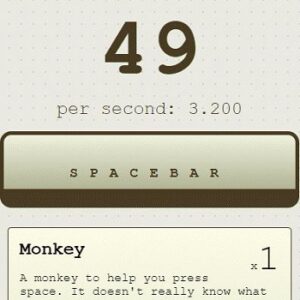
Cursor * 10 and Spacebar Clicker push the idea toward fast input and escalating modifiers. Instead of treating clicking as a background action, they make the input itself the focus of the challenge. That creates a slightly different skill set, where the player is watching for efficiency, timing, and rapid escalation rather than simply waiting for numbers to rise.
Idle Growth And Automation
A large part of the category is defined by automation. Idle Miner, Mineclicker, Realm Grinder, and Antimatter Dimensions all move beyond manual input and place greater emphasis on systems that continue working over time. Once the initial loop has been established, the player spends more attention on choosing upgrades, balancing production chains, and deciding when to reset or reinvest.
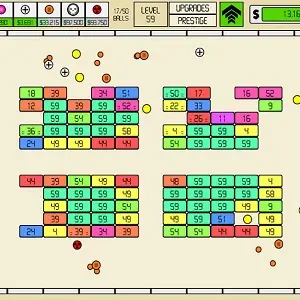
Idle Breakout fits this model in a recognizable but slightly more active way. It takes a familiar arcade structure and turns it into a resource engine, so progress comes from managing growth rather than chasing a score in a traditional sense. That hybrid approach appears in other games in the category as well, where the line between action and automation becomes blurred.
Realm Grinder stands out among clicker games for the sense of progression layering it introduces. It is not just about increasing one number; it is about choosing how to improve a broader system. Antimatter Dimensions takes that same appetite for compounding into more abstract territory, appealing to players who enjoy watching exponential growth unfold across multiple layers of advancement. These are the clicker games that reward patience, planning, and a willingness to think several steps ahead.
Themed Variations On The Same Loop
One of the clearest patterns in clicker games is how often the genre adopts everyday themes. Doge Miner 2 frames progression around mining and cryptocurrency-style resource collection. Money Clicker turns the loop into a direct financial climb. Pizza Clicker and Donut Clicker use food production as the central metaphor, while Cookie Clicker keeps the format anchored to one of the most recognizable idle-game themes. The subject matter changes, but the underlying structure remains about production, upgrades, and scaling output.
Pokemon Clicker and Puppet Master show how clicker mechanics can be adapted to different fantasy frameworks. Instead of merely producing a generic currency, the player is advancing through a themed system that gives the numbers context. This matters because clicker games often depend on the player’s ability to mentally track progress. A strong theme gives that progress a more tangible shape.
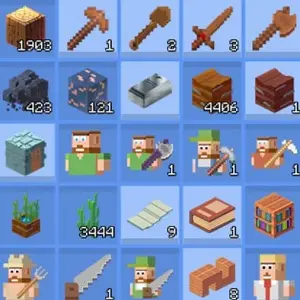
Grindcraft and Mineclicker are especially useful examples of how crafting and resource extraction fit into the category. They move closer to management and construction than to pure repetition. Rather than clicking for a single reward, the player is often working through chains of collection and conversion, which creates a more layered sense of advancement.
Progression, Prestige, And Long-Term Planning
The deeper clicker games become, the more they rely on progression systems that extend far beyond the first few minutes. Evolve and Antimatter Dimensions suggest the scale of that design, where each stage of growth feeds into a larger structure. In these games, the player is not only increasing production but also learning when to shift strategy, when to invest in efficiency, and when to reset for stronger returns later.
This long-term structure is what separates the more demanding clicker games from the lighter novelty titles. A game such as Idle Miner may emphasize steady expansion, while Realm Grinder and Antimatter Dimensions ask for a more deliberate approach to systems and multipliers. The decision-making becomes less about immediate reward and more about choosing the route that will pay off over a much longer timeline.
That progression style attracts a specific kind of player: someone who likes visible growth, but also wants enough depth to make upgrades matter. The best-known clicker games in this category do not rely on a single mechanic for long. They add layers, unlock automation, and create a sense of momentum that keeps the economy moving even when the player is no longer clicking constantly.
Action-Focused Variants And Hybrid Designs
Not every clicker game is purely about passive income. Idle Breakout uses a familiar action format as the foundation for idle progression, which makes the category more varied than it first appears. Spacebar Clicker also shifts attention toward input speed, turning a simple control into the central challenge. In both cases, the loop is still based on accumulation, but the method of accumulation is more active and immediate.
That hybrid design matters because it gives clicker games room to appeal to different habits. Some players want to make one efficient decision and then watch the system unfold. Others prefer a more hands-on rhythm, where the act of input remains central even as automation grows. Games like Cursor * 10 sit comfortably between those approaches by making the click itself part of the progression puzzle.
Why Clicker Games Keep A Broad Audience
The category works because it supports a wide range of goals. A player can load Cookie Clicker or Candy Clicker for a relaxed session built around simple upgrades. Someone looking for a more structured economy may prefer Grindcraft, Mineclicker, or Idle Miner. Those who enjoy massive scaling and abstract progression usually gravitate toward Realm Grinder or Antimatter Dimensions. Meanwhile, faster, more input-heavy games such as Spacebar Clicker and Cursor * 10 reward quick reactions and repeated bursts of activity.
That variety also explains why clicker games remain easy to understand but hard to exhaust. The earliest goals are always accessible: earn a little more, buy a better upgrade, and unlock faster production. After that, the structure can branch into automation, layered economies, and long-term optimization. The category keeps the same basic foundation, yet the games built on it can feel casual, strategic, abstract, or highly system-driven depending on how far they push the loop.
 Obby: +1 Laser to Break Walls
 Candy Clicker 2
 Whack Your Ex
 Capybara Clicker
 Cookie Clicker
 Doge Miner 2
 Donut Clicker
 Pizza Clicker
 Grindcraft
 Mineclicker
 Realm Grinder
 Cursor * 10
 Evolve
 Antimatter Dimensions
 Tube Clicker
 Pokemon Clicker
 Candy Clicker
 Cookie Clicker 2
 Pizza Clicker 2
 Puppet Master
 Spacebar Clicker
 Money Clicker
 Idle Breakout
 Idle Miner
 Particle Clicker
 Babel Tower
 Idle Ants
 Minecraft Clicker
 President Simulator
 Room Clicker
 Anti Idle
 Mr. Mine
 Enchanted Heroes
 Idle Dice
 Doge Miner
 I Want To Be A Billionaire 2
 Planet Clicker 2
 Poop Clicker
 Universal Paperclips
 Planet Clicker
 Leek Factory Tycoon
 Smash Your Computer