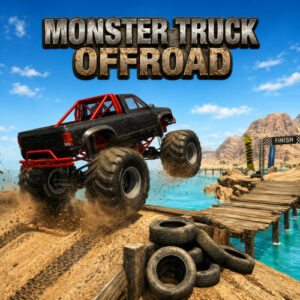
 Monster Truck Offroad

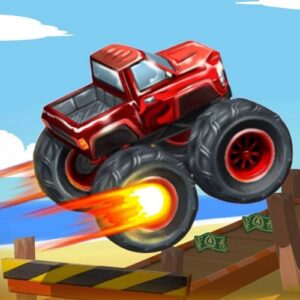
Monster Truck Games Built Around Weight, Momentum, and Control
Monster Truck games on browser platforms usually center on a simple idea with a lot of mechanical depth: heavy vehicles, uneven terrain, and the constant need to manage balance. In Monster Truck Offroad, Jelly Truck, Kick Buttowski, and Endless Truck, the vehicle is never just moving forward. Every slope, landing, and hill changes how the truck behaves, which makes timing and positioning as important as acceleration. That focus gives the tag a clear identity. These games are less about realistic driving and more about reading terrain, preserving momentum, and recovering from awkward angles before the truck flips or stalls.
The tag also covers more than one style of play. Some games lean toward obstacle-course precision, while others emphasize repeated runs, distance, or stunt-friendly routes. The result is a collection that rewards quick reactions but also punishes careless inputs. Even when the controls are straightforward, the physics create pressure that turns basic movement into a skill test.
Physics Is the Main Opponent
The most important design pattern across Monster Truck games is the way physics shapes every decision. Jelly Truck makes this especially clear by giving the vehicle a soft, wobbly feel that exaggerates every bump and landing. That approach is different from the firmer handling in Monster Truck Offroad, yet both games rely on the same core tension: the truck is powerful, but not stable enough to ignore the ground beneath it.
This is why these games often feel more technical than they first appear. Climbing a steep hill may require speed, but too much speed can send the truck airborne and force an ugly landing. Slowing down can help with balance, yet it can also leave the vehicle stuck on an obstacle. The player is constantly weighing momentum against control, and that balance is where the genre finds most of its challenge.
Tracks Designed for Recovery, Not Just Speed
Monster Truck games rarely use flat roads as their main playground. Instead, they build routes that create repeated recovery moments: ramps, broken ground, angled platforms, and uneven climbs. Endless Truck works well in this structure because the emphasis is not only on surviving a single obstacle, but on staying composed across a longer run where the terrain keeps changing. Kick Buttowski uses a similar logic, though with a more stunt-oriented feel that encourages the player to treat the course as a sequence of jumps and landings rather than a simple race.
That design favors players who enjoy learning route behavior through repetition. A difficult section is rarely just about pressing a button at the right time; it is about understanding how the truck will tilt, bounce, and settle. The games create a rhythm of failure and adjustment, where each attempt teaches something useful about speed management or landing angle.
Stunts, Jumps, and the Appeal of Risk
Some Monster Truck games are built around the drama of airborne movement. Long jumps, steep descents, and risky landings give the genre much of its character. Kick Buttowski fits neatly into that space, where stunt logic matters as much as forward progress. The player is often encouraged to keep momentum high enough to clear obstacles, but not so high that the landing becomes unstable.
- Jump timing matters because early or late takeoff can ruin a landing.
- Landing control is just as important as launch speed.
- Momentum management separates smooth runs from repeated crashes.
This balance of risk and recovery is one reason the tag remains appealing. The games do not simply ask for fast reactions; they ask players to accept that speed has consequences. The best runs often come from controlled aggression, where the truck is pushed hard but still kept upright through careful handling.
Distance Runs and the Pull of Repetition
Endless Truck represents a different side of the tag, where progress is measured over time rather than by completing a fixed course as cleanly as possible. That structure shifts attention toward consistency, upgrades, and incremental improvement if those systems are present, but even without elaborate progression the main goal remains the same: last longer, cover more ground, and make fewer costly mistakes.
Compared with the more obstacle-focused feel of Monster Truck Offroad or the stunt-heavy pressure of Kick Buttowski, endless-style design creates a more gradual challenge curve. It suits players who like repeat runs and small improvements. Every attempt becomes a test of endurance, and that makes pacing especially important. Too cautious, and distance suffers. Too reckless, and the truck loses control before the run can build momentum.
What Monster Truck Games Reward Most
The strongest common thread across the tag is that success depends on reading motion rather than merely steering. Monster Truck Offroad asks for terrain awareness, Jelly Truck emphasizes unstable physics, Kick Buttowski pushes stunt timing, and Endless Truck rewards staying composed over longer stretches. Together, they show how Monster Truck games convert a familiar vehicle into a precision tool.
That is why the tag attracts different kinds of players at once. Some prefer the challenge of mastering awkward physics. Others want a stunt course that turns every hill into a set piece. Others are drawn to distance-based runs where gradual progress matters more than perfect execution. Across all of them, the truck itself remains the same kind of machine: heavy, difficult to control, and satisfying when the player finally makes the terrain work in their favor.