 Baseball Bros IO
Baseball Games
Baseball Bros IO
 Ship Smasher
 Doodle Baseball
 Google Doodle Baseball
 ESPN Arcade Baseball
 4th of July
Baseball games on browser pages usually distill the sport into a few readable decisions: timing the swing, judging pitch movement, and reacting quickly enough to turn a simple at-bat into a scoring opportunity. In Google Doodle Baseball, ESPN Arcade Baseball, and 4th of July Baseball, the emphasis is less on full league management and more on the moment-to-moment rhythm of hitting. That makes the tag easy to approach, but it also leaves room for different interpretations of the same sport.
These games tend to strip baseball down to its most recognizable action. Players are not usually handling long defensive sequences or complex roster systems; instead, they are dealing with concise challenges built around contact, timing, and run production. That structure gives baseball games a clear learning curve. New players can understand the goal immediately, while more experienced players start chasing cleaner timing windows, better shot placement, and more consistent scoring.
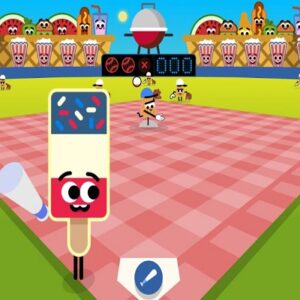
The most noticeable split across these games is tone. ESPN Arcade Baseball leans into a more traditional sports-game presentation, where the action still resembles baseball as a competitive sport, even if simplified for quick play. By contrast, Google Doodle Baseball uses a lighter, more playful setup, turning the sport into a compact reaction challenge. 4th of July Baseball adds a holiday theme that shifts the mood again, showing how the same basic rules can feel different when wrapped in a seasonal presentation.
This contrast matters because baseball games can be about more than accurate simulation. Some players want the familiar logic of baseball in a streamlined format; others want a themed version that plays more like a reflex test with sporting rules attached. The tag covers both impulses. The sport remains recognizable, but the appeal changes depending on how much structure the game preserves and how much it stylizes the experience.
Across these titles, batting is the central skill. The player’s success depends on reading the pitch, committing at the right moment, and making contact cleanly. That creates a strong feedback loop: early attempts often feel reactive and uncertain, but repeated play teaches patterns in timing and ball speed. Baseball games are especially good at rewarding small improvements, because a better swing timing window can translate immediately into extra hits or longer rallies.
Google Doodle Baseball and 4th of July Baseball both support this kind of quick repetition, where each attempt becomes a fresh chance to refine timing. ESPN Arcade Baseball similarly benefits from practice, but usually with a slightly more competitive framing. The player is not just hitting for contact; they are trying to make efficient offensive plays under pressure. That difference gives the tag a useful range, from casual pick-up batting to more score-driven challenge chasing.
Browser baseball games often work in short bursts, and these examples fit that pattern. Because the core loop is so immediate, players can restart quickly and treat each round as a self-contained attempt at improvement. The design encourages repetition, but not in a grind-heavy way. Instead, it relies on the appeal of incremental mastery: one more run, one cleaner hit, one better read on the next pitch.
That makes the tag especially friendly to players who enjoy measurable progress without a long tutorial. A beginner can focus on simply making contact, while a more advanced player may start optimizing shot placement or aiming for longer streaks. In games like ESPN Arcade Baseball, that can turn into a light competitive mindset. In Google Doodle Baseball, the same mechanic feels looser and more approachable. The underlying motivation is similar, but the pressure level is not.
4th of July Baseball shows how a holiday theme can reshape baseball without changing its core structure. The sport becomes a backdrop for a seasonal mood, which can influence the visual style, pacing, and overall personality of the game. That is common in browser baseball: the rules may stay familiar, but presentation does a lot of work in defining the experience.
This is why the tag attracts different kinds of players. Some are drawn to the sport itself and want fast, readable versions of batting. Others enjoy the themed presentation, especially when a game like Google Doodle Baseball uses a more informal tone. And players who prefer a more recognizable sports framing may gravitate toward ESPN Arcade Baseball. Together, these games show that baseball on the browser can be serious, playful, or seasonal while still centering the same essential test of timing and control.
The sport’s structure makes it ideal for concise browser adaptations. A pitch arrives, the player responds, and the result is immediate. That clarity helps games like Google Doodle Baseball, ESPN Arcade Baseball, and 4th of July Baseball remain accessible without losing the tension that comes from a single swing deciding the outcome. Even when the presentation changes, the basic challenge stays easy to understand and difficult to perfect.
Because of that, baseball games often appeal to players who want quick rounds with visible improvement. They reward attention, timing, and pattern recognition more than complicated controls. The tag works because it can make a well-known sport feel compact, legible, and replayable while still leaving room for different moods and levels of intensity.